Canada and the EU Launch an ‘Alliance for the Future’
After two days in Montreal, Ottawa and Brussels promised the deepest partnership short of membership — and a new label that not everyone in Europe accepts.
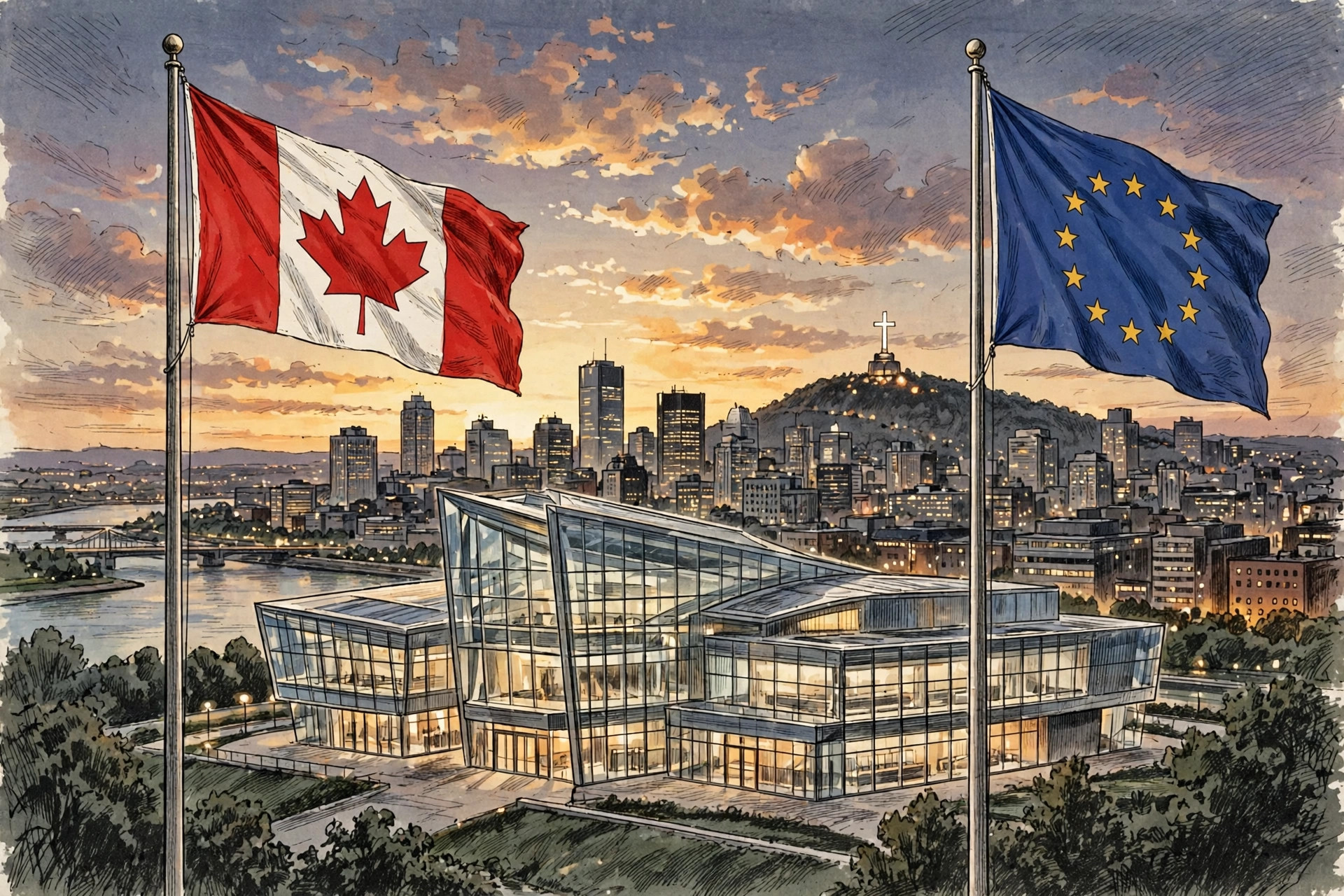
Canada and the European Union launched a new partnership on Friday, closing a two-day summit in Montreal with a promise to tie their economies, militaries and research systems closer together. The leaders called it the Alliance for the Future, and said other like-minded countries would be welcome to join.
Prime Minister Mark Carney hosted European Council President António Costa and European Commission President Ursula von der Leyen for the 21st Canada-EU Summit, held October 29 and 30. In a joint statement, the three leaders cited a commitment to multilateralism, democracy and the rules-based international order, and said they would work to resolve the conflicts in Ukraine and the Middle East and deepen security ties, including in the Arctic.
The headline ambition goes further than the existing trade relationship. Carney said Canada and the EU are working toward the deepest possible partnership short of accession, with Canada becoming the European Union’s first Associate Member. Over the coming months, the two sides will determine the substance, scale and scope of that form of membership, according to the Canadian government’s account of the summit.
Carney said he had accepted Costa’s invitation to attend European Council meetings in Europe next June, where he said talks on the deeper relationship would be concluded. Canadian ministers and European commissioners are scheduled to meet in March to push the talks forward.
The label not everyone accepts
The associate member label is the part of the deal with the least agreement behind it. It has no legal meaning and no precedent in the EU’s treaties, and it does not appear in the summit’s final joint statement, which instead speaks of an “ever closer association.” Reuters reported that Germany and several other member states opposed the term, arguing they could not sign up to a concept that had no legal status and had not been fleshed out.
Von der Leyen has continued to use the term anyway. She described the idea as “an association without accession” and, according to The Guardian, called it uncharted territory. Costa backed her ambition at a summit lunch while joking that the final designation was “subject to revision.”
Carney has said Canada is not seeking EU membership. At home, Conservative leader Pierre Poilievre opposes associate membership, equating it with a loss of sovereignty. “We will never be the 51st state of the US, but we will also never be the 28th state of the European Union,” he said ahead of the summit.
What was actually agreed
Beyond the label, the summit produced a list of concrete measures. Canada and the EU concluded a Digital Trade Agreement and finished negotiations on a Competition Agreement. Canada joined the European High Performance Computing Joint Undertaking, giving its researchers access to the JUPITER supercomputer.
On resources and energy, the two sides signed a framework allowing the European Investment Bank to invest in Canadian critical minerals projects, and agreed to study increased Canadian liquefied natural gas exports to Europe and a new transatlantic data cable.
On defence, Canada signed its second contract under the EU’s Security Action for Europe initiative, worth more than $44 million, for Montreal-based Galvion to supply military helmets to Latvia. On Ukraine, Carney announced Canada would contribute an initial €500 million toward the EU’s €90 billion support loan for the country.
The two sides also pledged to explore a next-generation youth mobility partnership. Von der Leyen said the goal is for Canada to fully join Erasmus+, the EU’s student exchange program, and Canadian officials said the target is midway through 2027, with full membership in the Horizon Europe research program aimed for 2028.
The push to deepen ties comes as Carney looks to reduce Canada’s economic reliance on the United States. Reuters reported that closer ties to Europe are part of that strategy since President Donald Trump imposed tariffs on a range of Canadian goods. The EU is Canada’s second-largest trading partner, and the two sides already trade under the CETA free trade agreement, provisionally in force since 2017.
What the associate membership label ends up meaning, if anything, will be settled in the months before the June meeting. For now, the alliance is a direction, not a finished deal — a set of signed agreements, a list of studies, and a name that both sides are still defining.