Tens of Thousands March Across Spain in Housing Protests
Congress struck down two emergency housing decrees on Friday. On Saturday, about 70,000 people marched in Madrid while police clashed with protesters in Valencia.
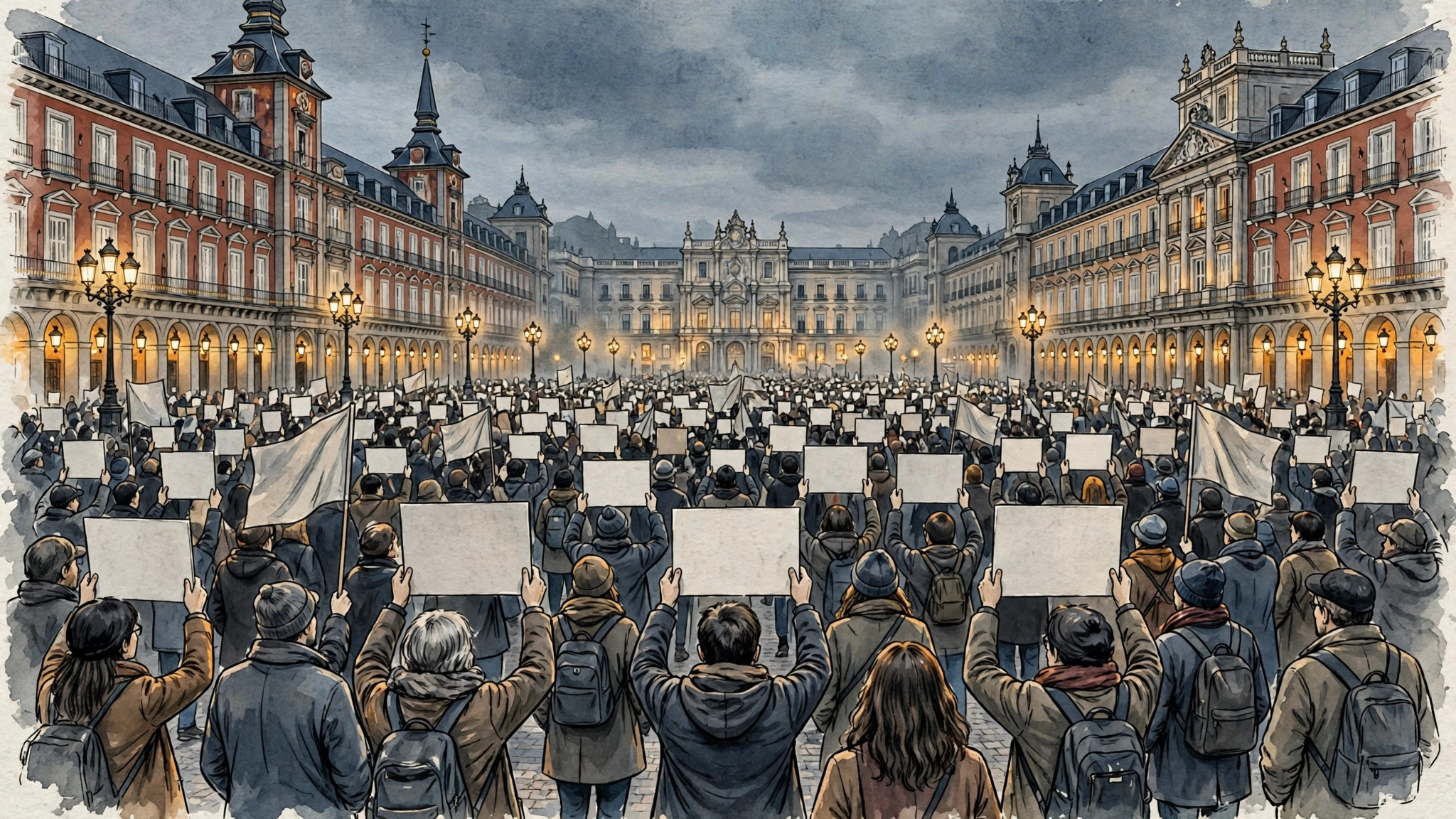
Tens of thousands of people marched in Madrid and other Spanish cities on Saturday, demanding action on the housing crisis a day after Congress voted down two government decrees meant to protect tenants.
About 70,000 took part in the Madrid demonstration, the Spanish government said. Marchers set off from four points across the capital at noon and converged on Plaza de Cibeles. Demonstrations in 50 other cities were peaceful, Reuters reported. The planned marches in Barcelona and nearby Hospitalet de Llobregat were called off because of heavy rain.
The protests were the latest wave of anger over the eviction of Maricarmen Abascal, 87, from the Madrid flat where she had lived for about seven decades. She was carried out on a stretcher. Housing campaigners said the investment company that bought her building had sought to raise her rent by 275 percent. After the backlash, the new owners agreed to let her return at a low rent.
The decrees
The two decrees would have restricted evictions of vulnerable tenants, extended rental contracts, and automatically renewed them when they expired. They also targeted speculation by investment funds — what housing campaigners call vulture funds.
Congress rejected the first decree 178 to 172. The conservative Popular Party, the far-right Vox, the Catalan separatist party Junts, and the Unión del Pueblo Navarro voted against. The second fell 184 to 166, with the Basque Nationalist Party and Coalición Canaria also voting no.
Junts argued the decrees lacked rigor and would hurt small landlords. Business and landlord groups had warned the measures would shrink the rental supply and drive prices higher. The unions that organized the marches had asked Congress to pass both decrees anyway, calling them insufficient but better than nothing.
Valencia turns violent
In Valencia, the day turned violent. Police fired rubber bullets and tear gas to break up the protest. About 30 demonstrators got inside the City of Arts and Sciences, the landmark cultural complex, before police forced them out.
Some marchers carried posters calling for a general strike. Valeria Racu, a spokeswoman for the Tenants Union, told reporters in Madrid that a strike would be called after talks with labor unions. The weekend’s slogan: “Towards a general strike.”
“It’s a shame,” said Nando de Anguulo, 26, who joined the Madrid protest. “It only proves that it is us the people who have to adapt to the political parties, and not the politicians to what the people want, and this can’t go on like that.”
A snap election?
The vote has raised questions about the government’s future. Spanish media reported Friday that Prime Minister Pedro Sanchez could call a snap election for November and would watch the strength of Saturday’s protests before deciding. His office refused to comment.
After the vote, PP leader Alberto Nunez Feijoo urged Sanchez to “call elections as soon as possible,” arguing he had the backing of neither the streets nor parliament. Recent opinion polls have generally placed the opposition Popular Party ahead of Sanchez’s Socialists.
Spain’s housing crisis has been building for years. Average rents have nearly doubled over the past decade, and asking prices for homes are up about 90 percent, according to real estate site Idealista. Activists have been camped for about a week in Puerta del Sol, one of Madrid’s main squares, and they show no sign of leaving.