Google's Satellite AI Chip Answers Its First Question From Orbit
The prototype satellite, launched October 1, ran Google's Gemma 4 model on a data-center chip and beamed back a haiku. The company calls it a first step toward data centers in space. The hard tests come next.
Google's first attempt at running its data-center AI chips in space has produced an answer. It was a poem.
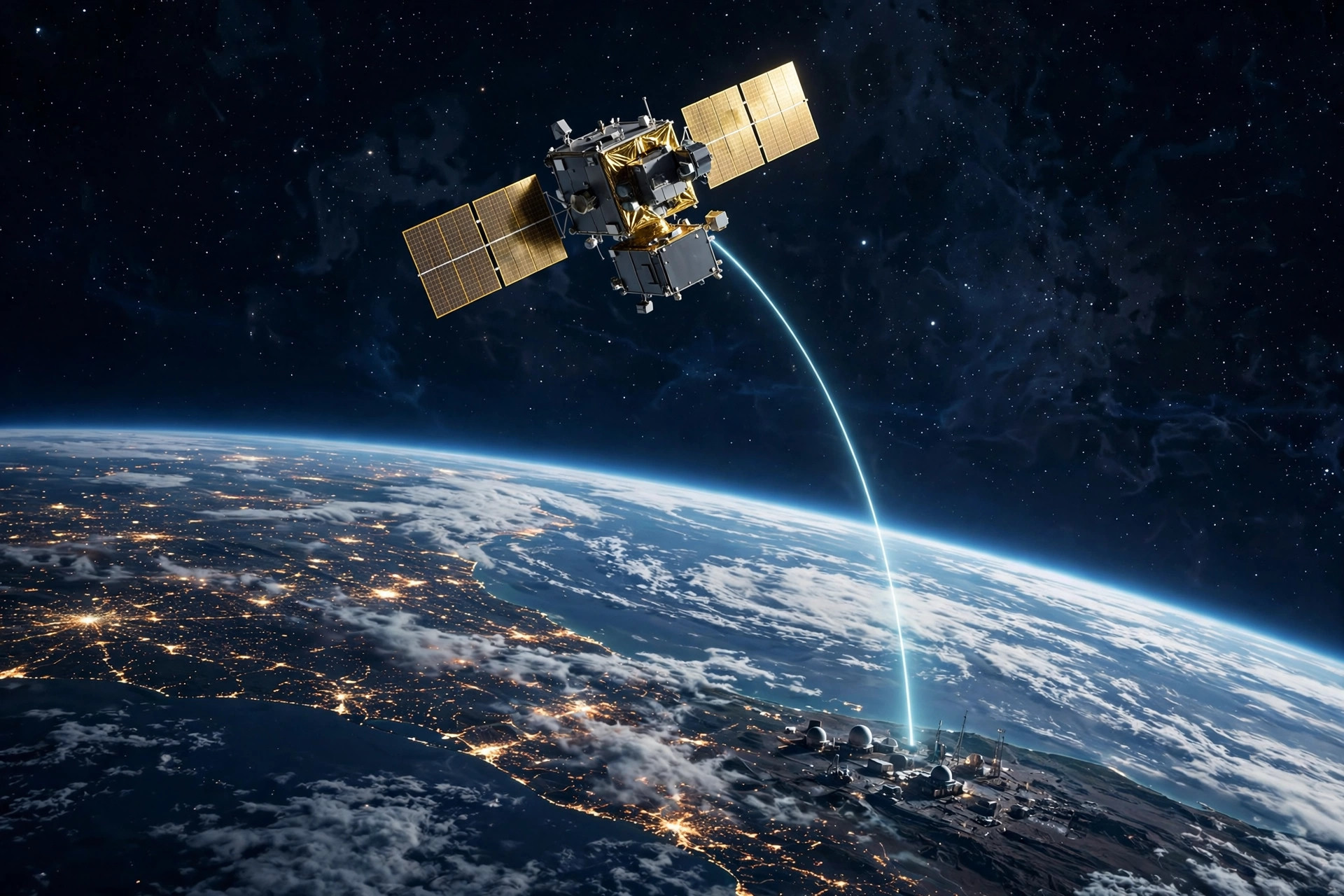
The company said October 30 that its Project Suncatcher prototype satellite had returned what it calls the first AI response from a data-center-class TPU in orbit. Engineers sent a prompt up to the satellite during a ground-station pass. The onboard model, Gemma 4, Google's open model, was asked to write a haiku about being in space. The answer came down as the satellite passed over Svalbard, Norway:
“Blue marble below / Data streams in silent grace / Starlight feeds my core.”
The announcement came from Travis Beals, a senior director at Google, in a company blog post. Google calls the moment a “Hello World” milestone. That is a fair description. The test proves the chain works, from uplink to chip to downlink. It proves nothing yet about speed, cost, or how long the chips last up there.
What is flying
The prototype launched October 1 aboard a SpaceX Falcon 9 rideshare mission from Vandenberg Space Force Base in California. It flew with more than 100 other spacecraft. Google built it with Planet, the satellite imaging company.
The satellite carries four Tensor Processing Units, the chips Google designs to run its AI models in data centers on Earth. It generates up to about 1 kilowatt of power from its solar panels. That is the catch. The chips draw so much power that only one can run at a time, for about 20 minutes at a stretch, according to TechCrunch. A Google spokesperson told TechCrunch the satellite is operating nominally.
After the haiku, the team tried more prompts. Space-themed limericks came next. Then came prompts asking the payload to report the technical status of its own systems. Those are still small workloads. Google has published no figures for how fast the chip runs in orbit, or how much it costs to run.
Why Google is doing this
Project Suncatcher is a long-term research effort. The idea is simple to state and hard to build: put AI computing in orbit, where sunlight is near-constant, instead of building ever-larger data centers on Earth that need land, water, and grid power.
Google first laid out the concept in November 2025. Its research paper sketched an illustrative constellation of 81 satellites flying close together in a dawn-dusk, sun-synchronous orbit, with neighbors 100 to 200 meters apart. The satellites would link to each other at high speed and share large workloads across the cluster. That is the vision. The prototype now in orbit is one satellite, running one chip at a time.
None of this is a product yet. Google has said the work is aimed at the 2030s, not next year.
What comes next, and what could go wrong
The next tests are the ones that will decide whether the idea survives contact with space. Google says it will test how the TPUs hold up under thermal stress and radiation exposure in orbit.
Both are real problems. In a vacuum, heat has nowhere to go except through radiators. A chip that runs hot in a server room with fans and liquid cooling has to shed that heat another way in space. Radiation is worse in a quiet way. A particle strike can flip a bit stored in memory, corrupting data without setting off the usual alarms. Google has tested its chips against particle beams in labs on Earth. Orbit is the real test.
If the chips hold up, Google plans to launch two interconnected satellites in 2027 to test high-speed optical links between spacecraft. That is the next step toward a cluster that can act like one machine.
One note of caution is in order. AI models have run in space before. What Google claims is narrower: the first response from its own data-center-class chip in orbit. The claim rests on Google's own report. No independent party has reproduced the test, and Google's post gives no orbital measurements. The haiku is real as far as the record shows. The data center in space is still an idea with one poem to its name.