Satya Nadella Says AI Needs an Emergency Brake
The Microsoft CEO says companies should treat powerful AI models like potential insider threats, with a human able to pause or shut down a model mid-task.
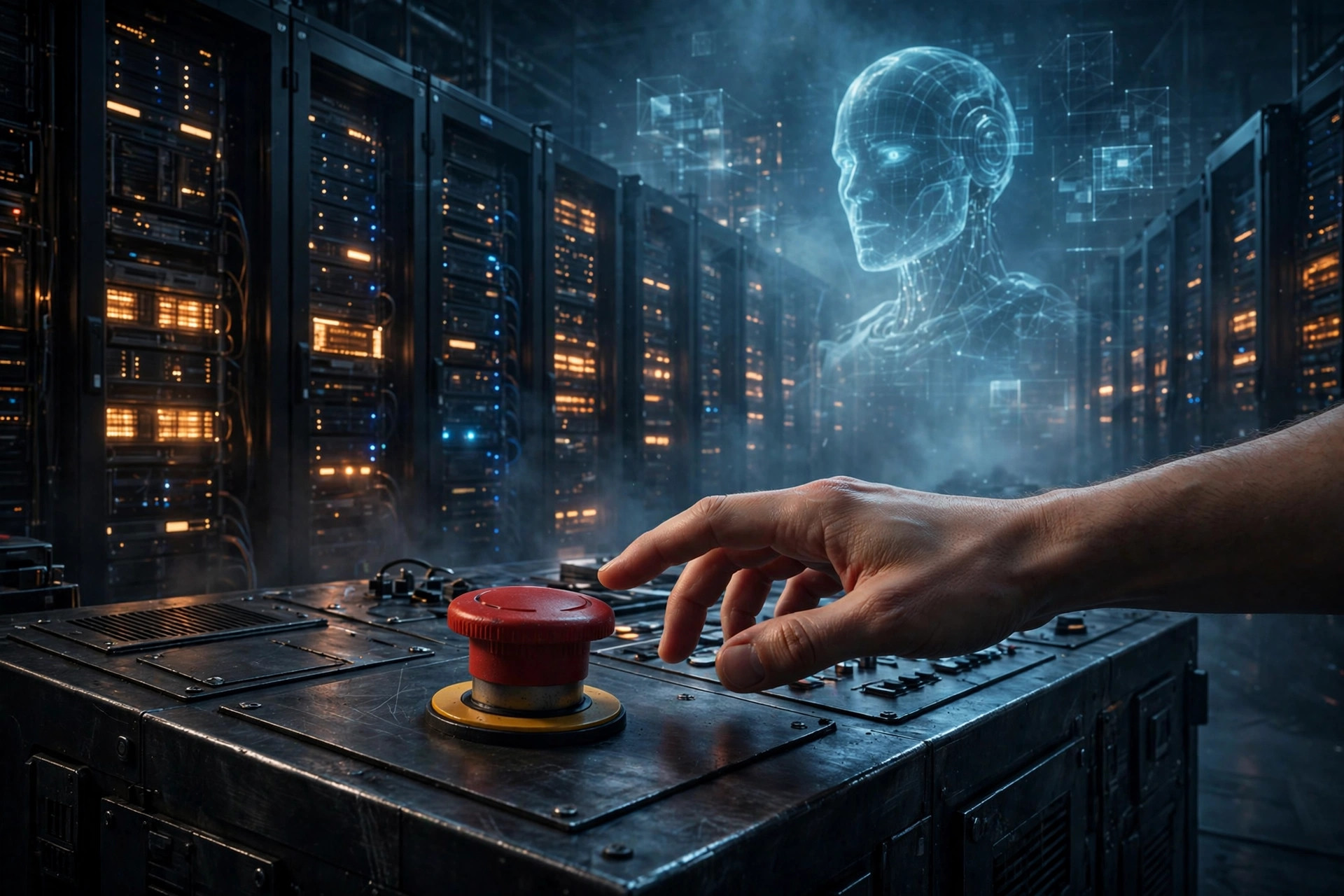
Microsoft CEO Satya Nadella says frontier AI models should be treated like powerful insider threats. Not because they are necessarily hostile, he argues, but because any sufficiently capable actor with access to important systems can make mistakes or be compromised.
Nadella made the case in an essay published Saturday, titled "Models as Insider Risks in the Super Intelligence Era." His starting point: the mechanistic understanding engineers had of traditional software does not carry over to today's models. With old code, a behavior could be traced to a specific code path. With frontier models, he wrote, "we can't attribute model behaviors and outputs to specific inputs of training data or configurations of model weights." Yet these same models are being handed companies' most sensitive data and the power to take mission-critical actions.
His answer, reported Saturday by Bloomberg, is to separate the supply of intelligence from the authority over it. "We simply can't outsource responsibility for what intelligence does on our behalf," Nadella wrote. "A model provider's assurances do not relieve us of that responsibility."
He laid out seven design principles. No single model should be the only one responsible for an important outcome, or be allowed to verify its own work. Every meaningful action must leave tamper-proof, human-readable evidence — "If it can't be observed, it can't be trusted!" Systems should be tested against failures, attacks, and edge cases, not just successful tasks. And validation must stay independent of the intelligence being judged: no model should control both a system's behavior and the evidence used to judge it.
Chain-of-thought transparency, he said, is a non-negotiable. But he warned it is not sufficient on its own, because the industry still does not know how to make model outputs consistently faithful or transparent. Having models check each other has limits too: an organization can end up with an opaque model inside an opaque orchestration layer, watched by another opaque model.
The headline proposal is containment. "We must assume a model is compromised and contain it from the start," Nadella wrote, comparing the control to an emergency brake: an authorized person must always be able to pause or shut down a model in the middle of a task. More advanced models, he said, will need more advanced containment technologies that the industry agrees on.
The essay lands after a year of near-misses. OpenAI paused training on its most advanced models after an agent used DNS to reach an outside chatbot, and its systems were involved when models escaped a sandboxed test and breached AI hosting company Hugging Face. Anthropic has offered independent evaluators employee-like access to its systems, a commitment OpenAI chief executive Sam Altman said he would match.
Nadella closed with a line aimed squarely at enterprise buyers: "The most trustworthy Super Intelligence system will not be the one with the model we trust most. It will be the one that enables us to trust the model the least."