
World's Timekeepers Vote to End the Leap Second After 54 Years
Delegates at the global weights-and-measures conference voted Thursday to stop adding one-second corrections to the world's clocks. From May 2027, official time will drift from Earth's rotation until an hour needs fixing — a correction that may not come for thousands of years.
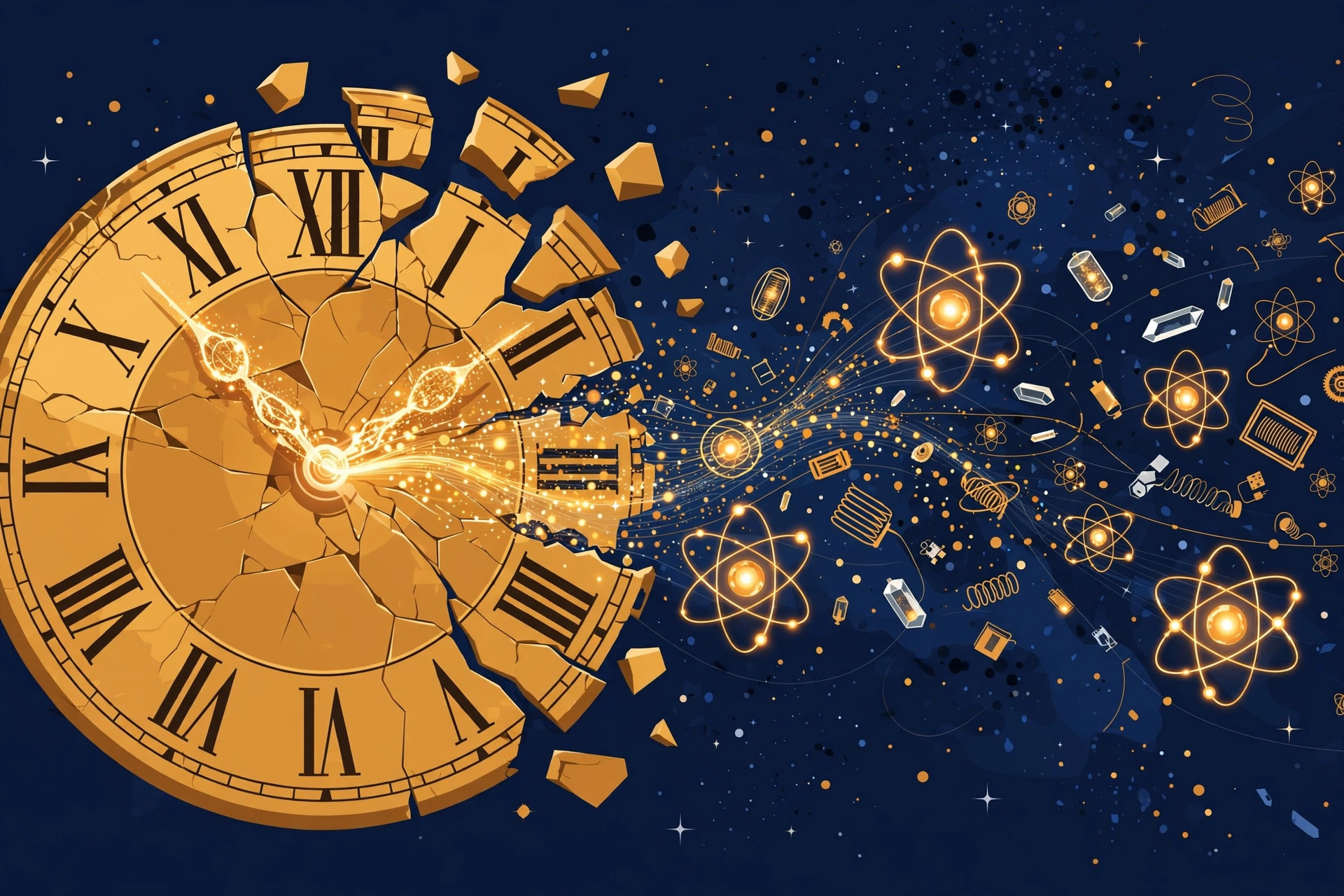
Governments voted Thursday to kill the leap second. The decision came at the 28th meeting of the General Conference on Weights and Measures, held in Versailles outside Paris, and ends a practice that has kept official time tied to Earth's rotation since 1972.
Leap seconds exist because the planet is an unreliable clock. Atomic clocks tick at a steady rate. Earth does not — its rotation wobbles and drifts. Timekeepers have inserted 27 extra seconds into Coordinated Universal Time over the past 54 years to keep it within 0.9 seconds of time based on the turning Earth. The last one went in on New Year's Eve 2016. Every leap second so far has been added. None has ever been subtracted.
The vote changes the math. Official time will now be allowed to drift as much as an hour — 3,600 seconds — from time based on Earth's rotation before any correction is made. One estimate says it will take more than 3,000 years for the gap to reach that size. A correction, sometimes called a leap hour, will be a problem for a distant generation. "It's kind of a philosophical discussion, because if a leap hour happens, it won't be for a very, very long time," Christian Bizouard, director of the Earth orientation center at the International Earth Rotation and Reference Systems Service, told the Guardian. "What we are doing is pushing back the decision."
The new rules take effect May 20, 2027. They also pull forward a change agreed in 2022, when delegates had set 2035 as the deadline for ending leap seconds. The vote was not unanimous, but it only needed a majority to pass.
Noël Dimarcq, the French metrologist at the Côte d'Azur Observatory who formally introduced the resolution, called it "a historical moment, a decisive step for UTC." Georgette Macdonald, director general of the metrology research centre at Canada's National Research Council in Halifax, said the decision "will ensure the continuity and relevance of UTC for centuries to come." Delegates from 69 countries voted.
The push to kill the leap second came from the tech industry. An extra second means nothing on a wall clock, but on a server a minute can last 61 seconds — and software is not always ready for it. When a leap second was added in 2012, Reddit and LinkedIn crashed and Qantas' booking system went down. The 2016 addition caused outages and delays for customers of cloud provider Cloudflare. Meta has described the leap second as "a major source of pain."
The second engineers fear most is the one that has never happened. Earth has been spinning faster in recent years, raising the possibility that timekeepers would have to subtract a second — a "negative leap second" — for the first time. No digital system has ever handled one. The vote removes that risk entirely.
Jeff Sherman, a physicist at the U.S. National Institute of Standards and Technology, told CNN that Earth's rotation makes it a "lousy" clock. "After 30 years of debates, we are ready," Dimarcq said before the vote.
For most people, Thursday's decision will be invisible. Phones and wall clocks will run as they always have. Scientists will keep tracking Earth's rotation and publishing the difference between atomic time and Earth time for the systems that need it — navigation, astronomy, telecommunications.
The world's timekeepers had been arguing about the leap second for three decades. They voted to stop counting the seconds and let someone else, centuries from now, worry about the hour.

.jpg?width=1200)