Four Corners Flooding Spreads Downstream as San Juan River Surges
Hundreds of homes remain evacuated across the Four Corners region after days of heavy rain pushed the San Juan River to levels unseen in over a century. On Sunday the flooding reached southeastern Utah, closing bridges and forcing evacuations in three towns.
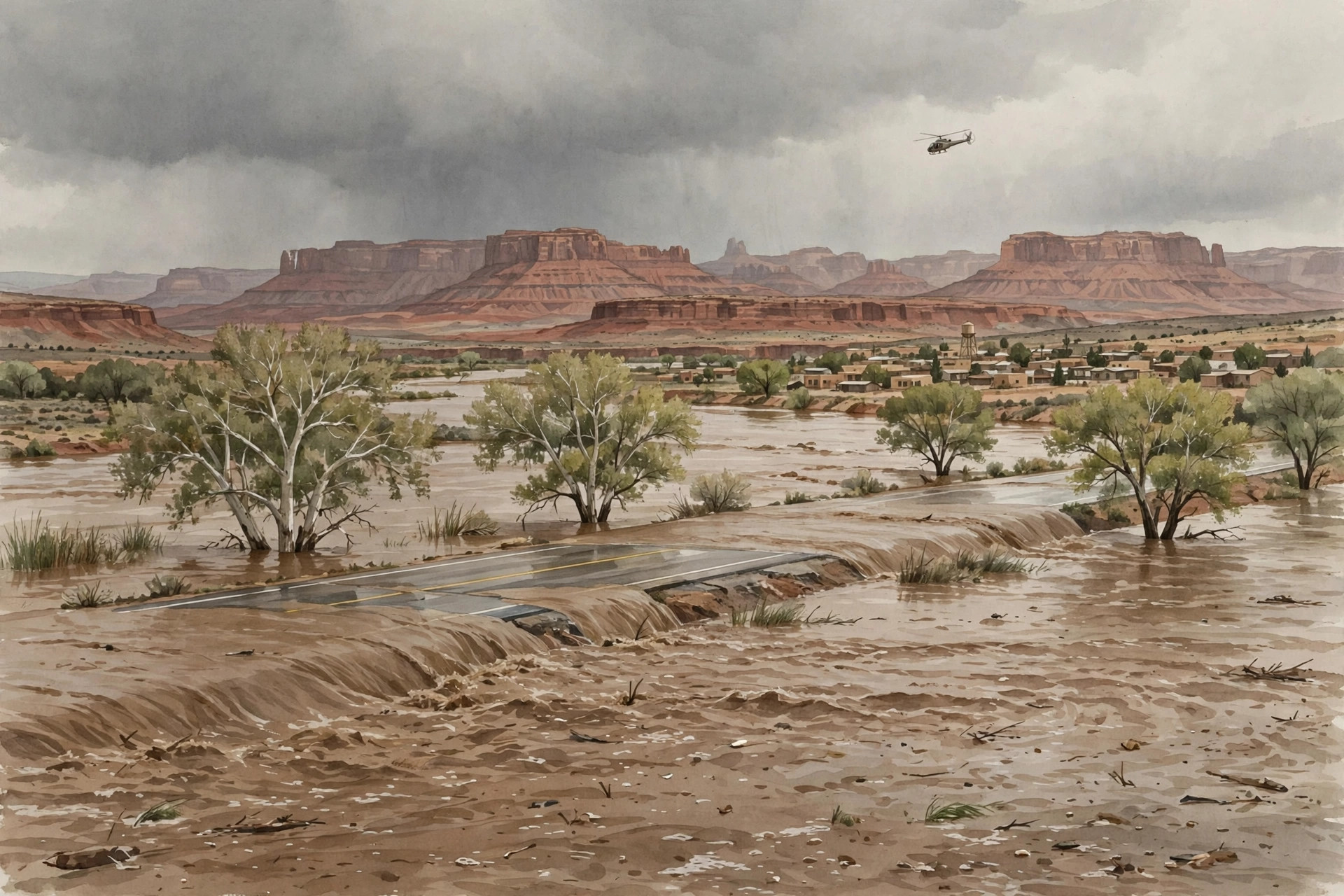
Hundreds of homes remained evacuated and without electricity Saturday after days of heavy rain surged out of the Colorado mountains and into the desert of the Four Corners region. More than 5 inches of rain fell in places. The rain picked up Wednesday, and the flooding peaked Thursday and Friday.
The flooding affected about 2,000 people in and around Farmington, New Mexico, a city of 46,000 not far from where Arizona, Colorado, New Mexico and Utah meet. At least a couple hundred people needed rescue. Some were stranded on rooftops. New Mexico National Guard helicopters flew 11 hoist operations, each hauling as many as eight people to safety, according to San Juan County spokesperson Devin Neeley.
Upstream in Colorado, the San Juan River ran through the hot springs resort town of Pagosa Springs at a level unseen in over a century. The flood stood well over 2 feet higher than one just over a year ago that officials had considered a 100-year flood. The Animas River ran in a muddy torrent through Durango, though below records dating back over a century.
On Sunday the water moved downstream. The National Weather Service office in Grand Junction warned of catastrophic flooding along the San Juan River between Four Corners and Mexican Hat, Utah, with floodwaters expected to crest around Aneth, Montezuma Creek and Bluff that afternoon and evening. The U.S. 160 bridge over the San Juan River near the Arizona-Colorado border stayed closed to traffic, and the Montezuma Creek Bridge closed as well, according to the Navajo Police Department. Navajo emergency management workers evacuated residents in Bluff, Montezuma Creek and Aneth.
Emergency shelters opened at Aneth Community School and at San Juan High School in Blanding, Utah. Police warned evacuated residents not to return home. The Weather Service warned people not to cross the river, saying low-water crossings were flooded and possibly impassable.
The storms also hit communities across northern Arizona. In Lower Moencopi, a Hopi village near Tuba City, flooding displaced as many as 10 families. Some residents fled with only the clothes they were wearing, a fellow resident said. Hopi officials reported damage to homes, roads, bridges and utilities across multiple communities.
Downstream from Farmington, the San Juan flooded parts of the Navajo Nation. A 2-mile stretch of U.S. Highway 64 west of Shiprock closed with water on the roadway. In Shiprock itself, flooding disrupted the wastewater treatment plant, and untreated wastewater was discharged into the San Juan River to keep sewage from backing up into homes and businesses. The water supply runs on a separate system and was unaffected, the Navajo Tribal Utility Authority said. It urged sewer customers to use less water and to keep children, pets and livestock away from the river.
Even as rivers receded from record highs, officials warned the event was not over. More storms moved through the region, and local officials warned of still more surges. “This is not over, and we need you to monitor alerts,” Farmington police Chief Steve Hebbe said at a news conference. Evacuations stayed in effect until officials deemed it safe to return, with downed power lines, leaking gas lines and more storms among the hazards.
“There’s a lot of anxiety, and there’s a lot of frustration,” San Juan County Sheriff Shane Ferrari said. “But please understand we are blocking those areas for your safety.” Shelters were not full, leading officials to suspect most evacuees were staying with friends and family. Officials in Colorado and New Mexico urged people not to fly drones to check on their property, warning that drones can endanger rescue aircraft, and asked people not to call 911 except for true emergencies.
Some routes reopened. The Million Dollar Highway, formally U.S. 550, reopened between Durango and Ouray after crews addressed water damage. U.S. 160 northeast of Pagosa Springs stayed closed. Colorado Gov. Jared Polis added Conejos County to the list of places eligible for disaster help as flooding extended east to the Conejos River.
The flooding is the latest from two months of on-and-off heavy rain caused by tropical moisture coming ashore from the Pacific. After months of drought, other recent deadly flooding struck the Grand Canyon and areas of New Mexico. The region’s rocky deserts are naturally prone to flash floods, and rain has saturated the soils, making flooding likelier still.